
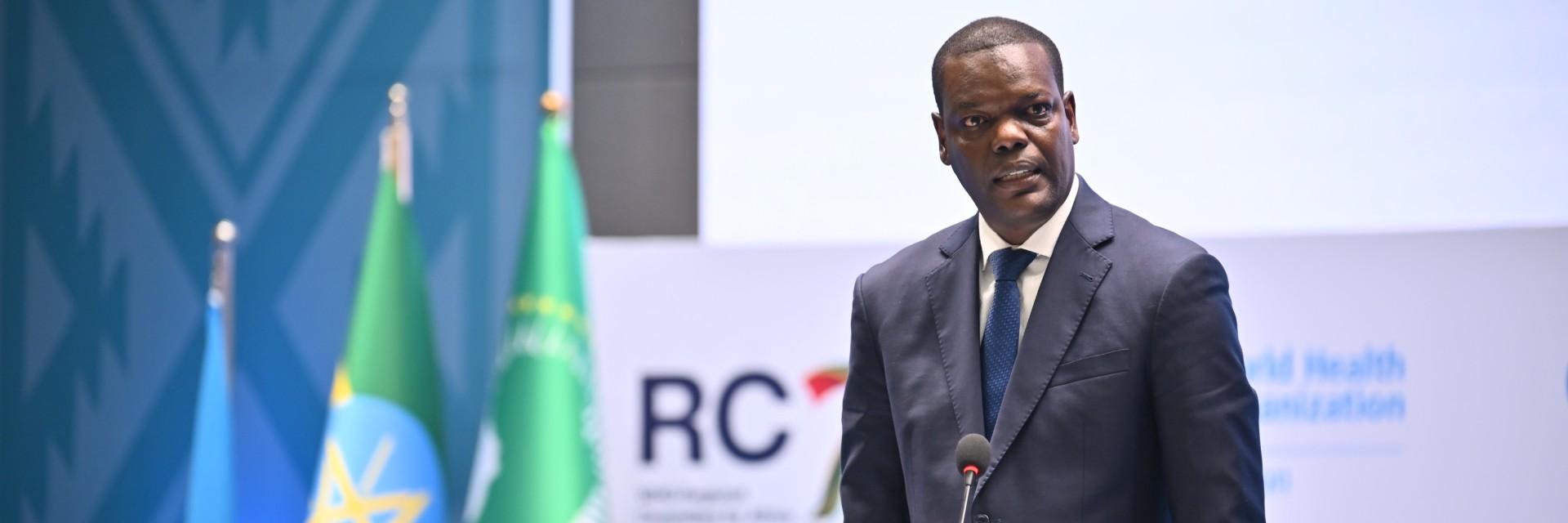

Statement at the Opening Ceremony of the Seventy-sixth Session of the WHO Regional Committee for Africa
Adwa Museum, Addis Ababa · Tuesday, 25 August 2026
Ceremony theme: “Roots and Wings – Heritage Meets Digital Health”
Mr Aboubakri Diaw, Chief of Staff, Economic Commission for Africa
Your Excellency President Taye Atske Selassie of the Federal Democratic Republic of Ethiopia and Guest of Honour,
Your Excellency Mahmoud Ali Youssouf, Chairperson of the African Union Commission,
Dr Tedros Adhanom Ghebreyesus, Director-General of the World Health Organization,
Honourable Dr Mekdes Daba Feyssa, Minister of Health of Ethiopia,
Honourable Dr Assa Badiallo Touré, Minister of Health and Social Development of Mali and Chairperson of the Seventy-fifth Regional Committee,
Dr Mohamed Yakub Janabi, WHO Regional Director for Africa,
Honourable Ministers,
Excellencies,
Distinguished delegates,
Ladies and gentlemen,
I have the honour to address you on behalf of Mr Claver Gatete, United Nations Under-Secretary-General and Executive Secretary of the Economic Commission for Africa.
ECA is proud to support the Government of Ethiopia and the World Health Organization in hosting this Seventy-sixth Session of the Regional Committee.
Your presence, Mr President, sends a powerful message. Health is not the responsibility of one ministry. It is a whole-of-government priority and a foundation of Africa's economic transformation.
There could hardly be a more meaningful venue for this ceremony than the Adwa Museum.
Adwa is first and foremost the story of citizens who united to defend their country’s sovereignty. Yet its meaning travelled far beyond Ethiopia, becoming a continental symbol of African dignity, agency and determination to shape our own future.
That spirit remains relevant to our health agenda today. Health sovereignty means Africa having the capacity to define its priorities, finance its systems, manage its data, produce essential health products and protect its people through future shocks.
The spirit of today's ceremony, “Roots and Wings, captures this ambition. Our roots are Africa's traditions of solidarity and collective responsibility. Our wings are innovation, digital transformation and the confidence to design solutions suited to our own realities.
But before systems, budgets and instruments; one person. Call her Amina. She owns a small catering business in an African city, employs two young people and supports her children.
When Amina becomes ill, she delays care because she fears the cost. When she finally seeks treatment, her condition has worsened. She uses her savings and sells part of her business equipment to pay the bills. Her business slows, her employees lose income and her children's schooling is at risk.
What began as one person's illness has become a household financial crisis, a small-business crisis and, when repeated across millions of families, a macroeconomic problem.
Amina's story reveals three challenges confronting sustainable health financing in Africa.
The first is a resource model under severe pressure. External health assistance declined by almost 30% while, in the median low-income country, debt servicing now consumes 7.5 per cent of public expenditure, more than the 6 per cent allocated to health.
The second is fragmentation and weak financial protection. Out-of-pocket payments account for an average of 35 per cent of current health expenditure in the Region; well above the WHO benchmark of 20 per cent. In the latest available estimates, 150million people in were pushed into poverty or deeper poverty by direct health payments. That is the toll of a single year.
The third is an implementation and confidence gap. Countries have developed health strategies, but these are not always translated into costed, sequenced and fiscally credible investment propositions. Weak budget execution and limited financial information make it harder to attract public, development and private financing.
Africa's health sector does not suffer only from a financing gap. It also suffers from a confidence gap and confidence, unlike capital, cannot be borrowed. It must be built.
Through the African Initiative on Transforming Health Financing, launched in Tangier in April 2026, and supported by Dr Senait and the Susan Thompson Buffet Foundation, ECA is bringing macroeconomic analysis and public-finance expertise into the health discussion. We are supporting country diagnostics and investment cases that link health to productivity, jobs, fiscal resilience and growth. Our preliminary analysis recognizes that the answer is not simply to raise more money. We must raise better, pool better, purchase better and account better.
From ECA's perspective, this requires three fundamental shifts.
First, we must reposition health from a recurrent social expenditure to a productive economic investment. How do we achieve this? By quantifying the economic cost of inaction and the returns generated by prevention and stronger health systems; by integrating health priorities into national development plans, macroeconomic forecasts and medium-term expenditure frameworks; and by linking budgets to measurable health and economic outcomes. We will partner with ministries of health so they come to the budget table not only with a statement of need, but with a credible investment case.
The second shift is from fragmented plans and parallel institutional discussions to nationally owned health-financing compacts.
A compact is much more than coordination between ministers of health and finance. It is a politically endorsed national agreement that establishes the outcomes, the reforms, the resources, who finances what and how delivery is measured.
It must bring together health, finance and planning authorities including revenue administrations, debt offices, insurers, banks, private partners and civil society — around one credible national proposition.
Putting more money into a fragmented system can finance more fragmentation.
Putting money behind a credible national compact can finance transformation.
With our early-adopter countries, we are building these pathways now, diagnosing constraints, identifying feasible reforms, and sequencing what comes first. Our preliminary work with early adopters shows that health receives only about 5 to 9 per cent of government budgets, while direct household payments can reach 64 per cent of health expenditure. The preliminary lesson is clear: there is no single financing solution. Each compact must combine budget reprioritization, stronger pooled prepayment, efficiency reforms and a managed transition from external financing, calibrated to the country’s fiscal and institutional starting point.
The third shift is from financing instruments in search of projects to country priorities matched with the right instruments.
A country facing low budget execution may need public-finance reform before it needs a new financing mechanism. A country transitioning from external assistance may need a carefully sequenced domestic financing pathway. A country seeking to manufacture medicines may require pooled procurement, regulatory harmonisation, guarantees and predictable regional demand. Innovation must therefore begin with the country's problem, not with the instrument.
On mobilizing private capital, and here the compact earns its keep. Investors need a lot of thing but there are three things that they need most : predictability (policy that holds, and governments that pay on time); pipeline (costed, investment-grade plans they can price); and information (reliable data on gaps and returns). Compacts, diagnostics and transparent data, supply exactly that; with the development finance institutions, they let us structure the blended and de-risking instruments that bring African pension funds, insurers and banks into health; partners who strengthen public systems, never substitutes for public responsibility.
Digital transformation must be treated as part of this financing architecture, not as a separate technical agenda.
When health and financial systems speak to each other, they connect the patient, the facility and the national budget — and show, in real time, whether spending is producing results. They turn efficiency and transparency from aspirations into daily practice.
Digital health is not simply about replacing paper with screens. It is about replacing fragmentation with visibility, replacing leakage with accountability and replacing uncertainty with trust.
Today, fewer than one third of health systems in low-income settings can track expenditure digitally in real time. Closing that gap is among the fastest efficiency gains available to any treasury.
The leadership of His Excellency Prime Minister, as the African Union Champion for Artificial Intelligence and Digital Health, is central to this transformation.
Ethiopia can demonstrate how digital identity, interoperable health information, real-time expenditure tracking and data-driven and increasingly AI-enabled decision-making can strengthen both health outcomes and fiscal accountability.
When every Birr or every Franc can be traced from the national budget to the health facility to the patient, digital health stops being a project and becomes a financing revolution.
Excellencies,
The respective strengths of WHO and ECA are highly complementary.
WHO brings public-health leadership, normative guidance and deep presence in national health systems. ECA brings macroeconomic analysis, public finance and the institutions that shape budgets and investment decisions.
Together, we can help transform health strategies into credible national investment propositions while protecting equity and public purpose.
The ultimate measure of success will not be the number of declarations adopted or the amount of money announced in conference rooms.
It will be whether Amina can seek care early, receive quality treatment and return home without selling the assets that sustain her family.
It will be whether her employees keep their jobs, her children remain in school and her business continues to contribute to the economy.
Universal health coverage becomes real the day seeking care stops costing a family its future.
Health is not what we spend when Africa grows. Health is how Africa grows.
Here at Adwa, history reminds us what Africa can achieve through agency, solidarity and shared purpose. Let us bring that same determination to financing the health of our people.
ECA stands ready to work with WHO, the African Union, member States and financing, technical and development partners to turn this ambition into financed, measurable and sustainable action.
I thank you.