
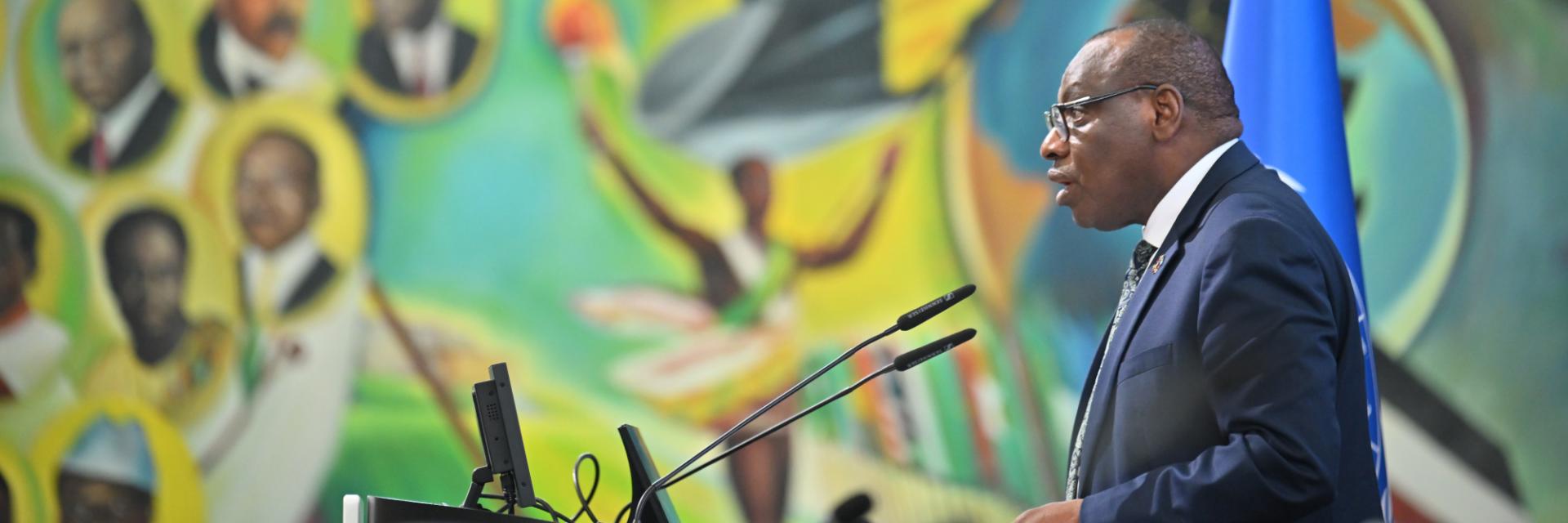
AFRICA REGIONAL MINISTERIAL MID-TERM REVIEW OF THE DOHA PROGRAMME OF ACTION (DPoA) 2022 – 2031
Opening Statement
By
Claver Gatete
United Nations Under-Secretary-General and
Executive Secretary of ECA
Addis Ababa, Ethiopia
8 September 2026
H.E. Tirumar Abate, Minister of State for Planning and Economic Development, Federal Democratic Republic of Ethiopia,
H.E. Rabab Fatima, Under-Secretary-General and High Representative for the Least Developed Countries, Landlocked Developing Countries and Small Island Developing States,
Honourable Ministers,
H.E. Lok Bahadur Thapa, Permanent Representative of Nepal to the United Nations and Global Chair of the Group of Least Developed Countries,
Distinguished delegates, partners and colleagues,
Ladies and Gentlemen:
Allow me at the outset to express our solidarity with the people of Nepal following the devastating floods and landslides. Our thoughts are with all those affected, particularly the families who have lost loved ones and those involved in the ongoing rescue efforts.
Let me also welcome you all to the Economic Commission for Africa. It is especially fitting that we are having this important meeting here in the historic Africa Hall, a place that has hosted some of the defining debates and decisions about Africa’s development.
I have no doubt, therefore, that our deliberations here over the next two days will add to that legacy.
I would like to thank the Government of Ethiopia and our colleagues at the United Nations Office of the High Representative for the Least Developed Countries, Landlocked Developing Countries and Small Island Developing States, under the leadership of Amb. Rabab Fatima, for co-hosting this important review.
Four years into the Doha Programme of Action, I think it is timely for us to pause and ask ourselves whether we are making progress at the pace and scale required.
Excellencies,
Thirty-two of the world’s 44 Least Developed Countries are in Africa.
That means the success of the Doha Programme of Action will depend, to a considerable extent, on the progress we make here on our continent.
And there has been some commendable progress.
Since 2021, women’s representation in national parliaments has increased by more than 9 per cent. The mortality rate among children under five has declined by nearly 7 per cent.
Access to water and sanitation have also improved. Electricity access has improved by 3.2 percentage points. And internet usage has increased by nearly 20 per cent.
These are important gains. But progress has not been even.
Social protection coverage has declined from 9.4 per cent in 2021 to 8.6 per cent today, while food insecurity has worsened.
The evidence also shows that our economies are still not transforming fast enough. African LDCs still account for less than one per cent of global merchandise trade.
Manufacturing value added accounts for only about 9 per cent of GDP. And major infrastructure and digital gaps continue to constrain productivity and opportunity.
Electricity access, for example, stands at 76.6 per cent in urban areas of African LDCs, compared with just 25.1 per cent in rural areas.
These constraints limit industrialization and productivity. They make it harder to create the decent jobs our growing young population needs. And they leave our economies more vulnerable to shocks.
At the same time, many African LDCs are trying to make this transition with very limited fiscal space.
Government revenues in African LDCs barely reach 15 per cent of GDP, compared with 24.3 per cent across developing economies.
Revenue performance also remains constrained by dependence on commodity-linked corporate taxes, large informal sectors, limited administrative capacity and illicit financial flows.
Debt pressures and tighter development finance further constrain the ability of governments to invest.
Excellencies,
The progress we are making in human development must therefore be matched by faster economic transformation.
And that starts with building the productive capacity of our economies.
Sustainable graduation from being an LDC requires economies that can produce more, add greater value and create decent jobs.
That means investing in reliable energy, transport infrastructure, skills, digital connectivity and technology. It also means accelerating industrialization and diversification so that our economies are less dependent on commodities and low-value activities.
But productive capacity alone will not be enough. We also need larger markets.
No African LDC should have to pursue structural transformation within the limits of its domestic market alone.
The African Continental Free Trade Area gives us an opportunity to build regional value chains, open up larger markets for African firms and help our LDCs become more competitive.
Regional integration can therefore provide an important pathway towards diversification and stronger participation in the global economy.
And none of this will happen without adequate investment.
Domestic resource mobilization must remain an integral part of our efforts. But with the fiscal constraints facing many African LDCs, domestic resources alone cannot meet the scale of investment required.
Therefore, we need greater access to affordable and predictable development finance. International financial institutions and development partners must respond to the particular circumstances of LDCs. And we must mobilize significantly greater private investment into productive sectors.
This is also where the international partnerships at the heart of the Doha Programme of Action remain critical. Our countries cannot be expected to finance this transformation alone.
Excellencies,
Graduation cannot simply be about crossing a statistical threshold.
It must mean stronger economies, greater resilience and development gains that can be sustained long after a country leaves the LDC category.
Accordingly, our task over these two days is to identify the concrete actions needed to accelerate implementation during the remaining years of the Doha Programme of Action.
The outcome of this conference will help shape Africa’s contribution to the global mid-term review in Doha next March.
As we prepare for that review, we must reaffirm our commitment to the development aspirations of Africa’s Least Developed Countries, and to ensuring that no country is left behind.
We should go to Doha with evidence of what is working, clarity about what is holding our countries back, and practical solutions for accelerating sustainable graduation in line with the ambitions of Agenda 2063.
In closing, I’d like to emphasize that:
Building our productive capacity;
Expanding our markets through the AfCFTA; and
Mobilizing the investment required to drive economic transformation are among the key imperatives for accelerating sustainable graduation and delivering lasting development gains for Africa’s Least Developed Countries.
I thank you.