
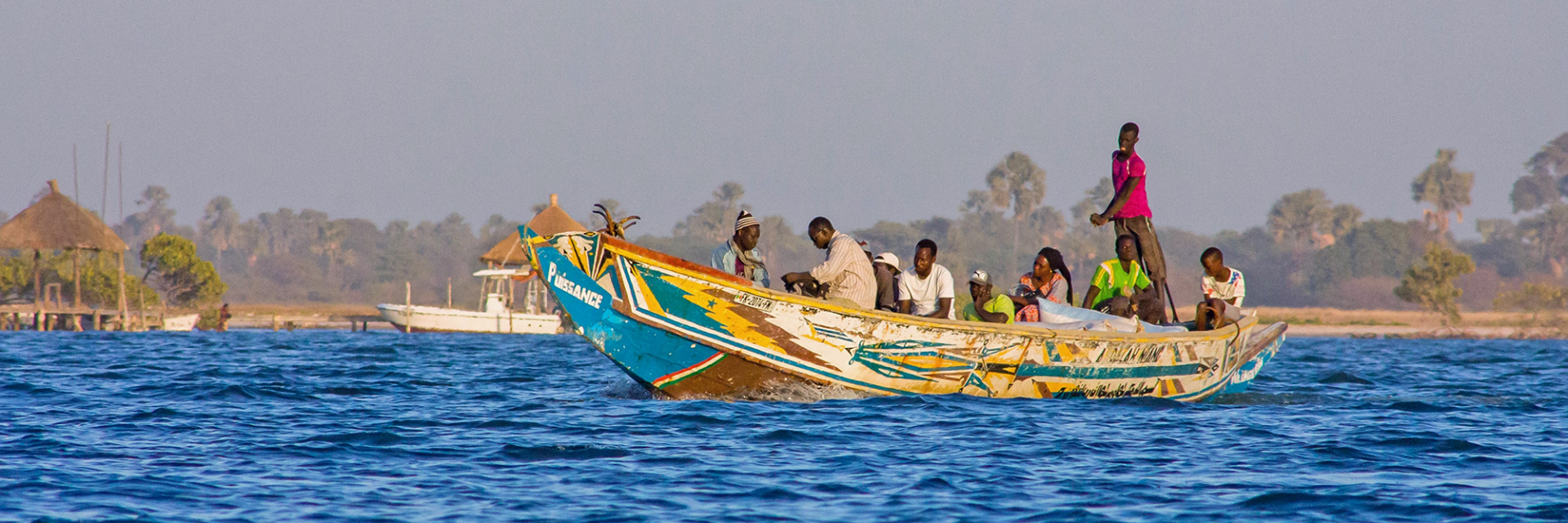
Yaoundé, 19 October 2026 (ECA) — Cameroon’s blue economy already generates an estimated 1.72 trillion CFA francs in gross value added, equivalent to 5.8 % of GDP, and supports nearly 300,000 jobs, or about 3 % of national employment. These findings are contained in Cameroon’s first national blue economy evaluation, supported by the United Nations Economic Commission for Africa (ECA) and handed over to the Government on 13 October 2026 on the margins of the 42nd session of the Intergovernmental Committee of Senior Officials and Experts for Central Africa (ICSOE).
The report, Socioeconomic and Ecosystem Assessment of the Blue Economy in Cameroon: Application of ECA’s Blue Economy Valuation Toolkit, also estimates the value of services provided by aquatic ecosystems at 22.6 trillion CFA francs a year, equivalent to 89.4 % of GDP. Nearly 80 % of this value comes from freshwater ecosystems. Water quality, climate regulation, habitats for species and coastal protection all support production and livelihoods. These findings highlight the scope for harnessing natural capital to support economic development.
The assessment identifies the sectors driving this economic contribution. Fisheries, aquaculture and fish processing account for more than two-thirds of the blue economy’s measured value added and over 80 % of its jobs. Accommodation and food services linked to coastal and water-based tourism account for about 15 % of this value added. The findings identify an existing productive base on which to attract investment, grow businesses and create higher-value jobs.
“This is a major opportunity to diversify our economy, create jobs, mobilise domestic resources and invigorate the private sector,” said Paul Tasong, Cameroon’s Minister Delegate to the Minister of Economy, Planning and Regional Development.
Requested by the Government of Cameroon, the study marks the first application in Central Africa of ECA’s Blue Economy Valuation Toolkit (BEVTK). The assessment was carried out with financial support from DANIDA (the Danish International Development Agency). The tool assesses the economic, social and ecological dimensions of activities linked to marine and inland water resources. A team of experts worked with national authorities to conduct the assessment. Its findings were validated during Cameroon’s Blue Economy Week, which opened on 24 January with ECA’s support for the Cameroon Beach Cleanup Day 2025, organized by the Association for Community Awareness (ASCOA) and other local environmental groups, before continuing with awareness-raising, training and validation activities from 27 to 30 January.
“We thank the Ministry of Economy and the Government of Cameroon for their continued trust in ECA and their sustained commitment to this process, as well as their growing role in advancing the blue economy nationally and across the region,” said Jean Luc Mastaki, Director of ECA’s Subregional Office for Central Africa.
To translate these findings into national wealth, the study recommends developing sustainable aquaculture and strengthening fish processing, preservation and marketing. Reducing losses and improving market access should help raise returns for producers and processors, strengthen food security and reduce dependence on external supplies. The study also calls for continued investment in ports and logistics, particularly around Kribi, with stronger links to fisheries, tourism and services.
Harnessing these opportunities also requires protecting the ecosystems that underpin them. “This is substantial natural wealth that is still not adequately reflected in public decision-making, investment policies and planning frameworks,” Mastaki said. Investment decisions therefore need to integrate the protection and restoration of aquatic ecosystems to safeguard the economic activities and communities that depend on them.
Effective coordination across ministries, with clear responsibilities, is also essential, alongside the integration of blue economy priorities into planning and budgets. The report recommends a pipeline of projects backed by impact indicators and risk assessments to mobilise public, private and concessional finance. Support for small and medium-sized enterprises in preparing bankable projects should help align the opportunities identified with investors’ requirements.
Investment should also expand opportunities for women and young people. The study recommends training for blue economy occupations, linked to internships, certification and partnerships with businesses, to help them enter the workforce. Stronger maritime security and regional cooperation are also needed to support the sector’s development.
Several activities, notably maritime transport and port services, are still not fully captured in the statistics. The report therefore recommends sustaining the use of the BEVTK, with the National Institute of Statistics leading this effort, a data development plan and regular updates to refine the baseline and track policy results.
“This socioeconomic and ecosystem assessment of our blue economy is a valuable tool for decision-making. We will put it to good use. We once again thank ECA for its continued support for our economic diversification efforts,” Minister Paul Tasong said.
The Cameroon assessment builds on Harnessing the Blue Economy in Central Africa: Opportunities and Challenges for Blue Growth, also launched on 13 October. The first study of the blue economy produced by ECA’s Subregional Office for Central Africa, the regional report recommended national assessments using the BEVTK to better quantify blue resources and guide their development.
By linking regional analysis, national assessment and priorities for action, ECA is helping countries harness their blue resources to diversify their economies. In the second half of Central Africa’s Decade of Economic Diversification (2021–2030), the aim is to expand production and employment while safeguarding the natural capital that sustains them.
Queries
Zacharie Roger MBARGA – Communications Officer
United Nations Economic Commission for Africa
637, Rue 3.069, Quartier du Lac, Yaoundé, Cameroon
Tel: (+237) 222 504 348
Email: zacharie.mbargayene@un.org
Read more:
Socioeconomic and Ecosystem Assessment of the Blue Economy in Cameroon [FR only]
Harnessing the Blue Economy in Central Africa: Opportunities and Challenges for Blue Growth
Issued by:
Communications Section
Economic Commission for Africa
PO Box 3001
Addis Ababa
Ethiopia
Tel: +251 11 551 5826
E-mail: eca-info@un.org