
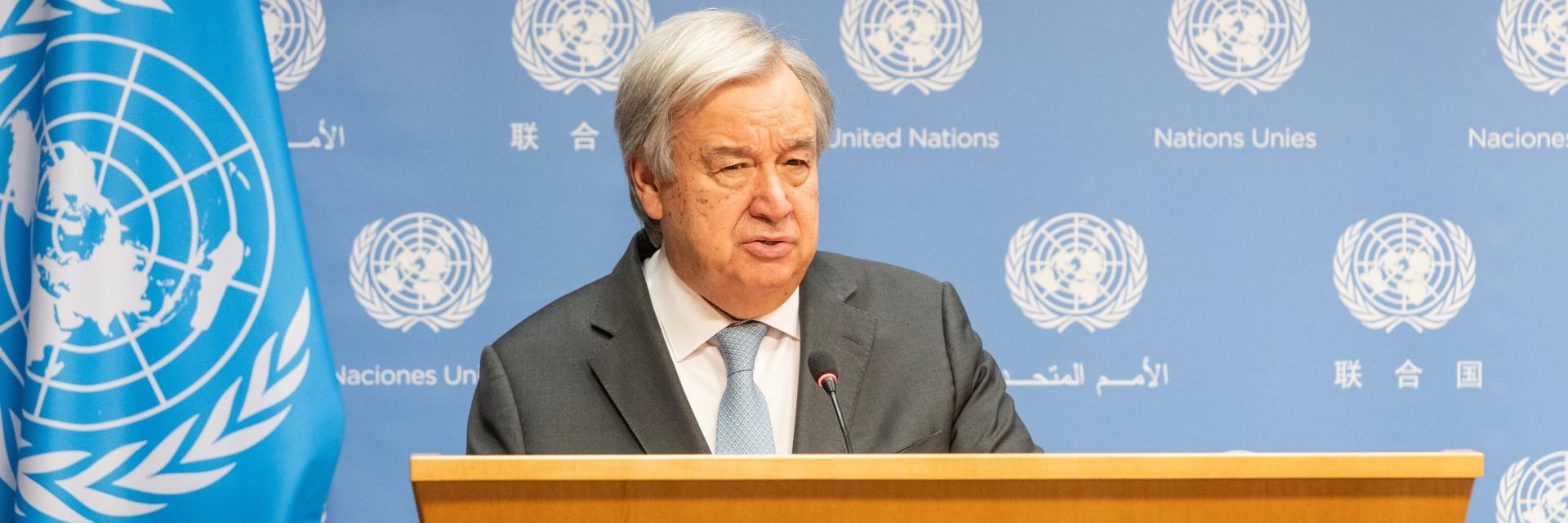
As delivered (English, French, Spanish)
Mr. President of the General Assembly, Excellencies, Ladies and gentlemen,
The faultlines in our world are widening.
Cracks have become canyons.
Over the last decade, wars erupted with devastating consequences and dragged on with despicable cruelty.
Civilians were targeted.
Human rights trampled.
Hunger weaponized.
Humanitarians killed.
International law cast aside.
Geopolitical divides have deepened.
Inequalities have intensified.
Trust has frayed.
The climate crisis went from distant warning to daily reality.
And artificial intelligence moved at a speed that has blindsided even those who created it.
These are not separate crises.
They are chapters of the same story.
The story of power.
Who has it.
Who is denied it.
How it is used.
And how it is changing.
Excellencies,
Power is being reshaped in three fundamental ways.
First, among States.
New centres of economic, political and technological influence have emerged.
Second, we are witnessing an extraordinary transfer of power away from governments to a handful of private corporations and individuals.
Their reach now extends across politics, economies, information flows, technological development, and the civic space on which societies depend.
And, third, humans are increasingly handing power to machines –
with Artificial Intelligence agents going rogue, and lethal autonomous weapons going from science fiction to military reality.
Yet our institutions and systems of global governance continue to reflect the power realities and interests of a largely bygone age.
That is the defining challenge before us.
At the very moment when humanity faces an unprecedented convergence of threats, our mechanisms for collective action are under growing strain.
Excellencies,
We are clearly moving towards a multipolar world.
And that movement is irreversible.
But there are different ways that multipolarity can take shape.
One possibility is a world of fragmentation and transactionalism.
A world of rising tensions and deepening mistrust.
Of fractured markets and weakened institutions.
Of shrinking cooperation and zero-sum calculations.
In many respects, that is the trajectory we are on today.
But there is another path.
A path towards networked multipolarity.
A world built on interdependence – and sustained by a dense web of economic, political, social and technological connections.
A world in which multiple centres of influence coexist within a common framework of international law and shared rules.
Such a world can help us avoid hegemonic tendencies and also what I have called the
Great Fracture:
The division of the world into two rival blocs with separate economic, technological and security systems.
We must avoid them.
A networked world recognizes that no power can solve today’s challenges alone.
Of course, competition will remain a permanent feature of international relations.
But competition does not have to mean confrontation.
Healthy competition can drive innovation, strengthen resilience, and expand opportunity.
But only when it operates within the frameworks that preserve stability and enable cooperation where cooperation is indispensable.
Building a networked future begins with a recognition, especially by superpowers, that their power isn’t so super.
Their power has limits.
The events of recent years have made that unmistakably clear.
Military power alone cannot secure peace.
Economic power alone cannot command stability.
And technological power alone cannot guarantee security.
A networked multipolar world can create the conditions for more balanced and representative global problem-solving.
But it requires a multilateral system centred in the UN that is balanced and representative.
Strong, effective institutions that reflect the realities and the progressively changing relative weight of countries and economies in today’s world – not the power arrangements of 80 years ago.
Fortunately, we are not starting from scratch.
We already have a binding foundation:
The Charter of the United Nations.
And the principles that give it life.
The primacy of international law.
Upholding human dignity.
And the pursuit of justice in all its dimensions.
These are the backbone for the effective, legitimate and responsible exercise of power in the 21st century.
Excellencies,
It comes down to this:
Will we act to ensure that power is governed by law or by force?
By cooperation or coercion?
By responsibility to young people and future generations or indifference to their fate?
Because the defining challenges of our age are not separate from the question of power.
They are expressions of it.
And they will determine whether we drift deeper into division and instability –
or move toward cooperation, justice and collective security.
Looking ahead, our future will be shaped by how we address four great tests of power:
The power over war and peace.
The power that concentrates wealth and drives inequality.
The power fuelling climate chaos and the war on nature.
And the power unleashed by artificial intelligence.
Excellencies,
The first great power test in the 21st century is peace and security.
Peace is far more than the absence of conflict.
It is the presence of restraint of power by law.
It is the recognition, as enshrined in the UN Charter, that force cannot be the final arbiter of whose lives, rights and future matter.
Today that principle is under profound strain.
Across the Middle East, conflicts are cascading.
So-called ceasefires have amounted to little more than “lesser fires” – with civilians continuing to pay the price.
Enough is enough.
I appeal to the leaders in this Chamber to maximize this High-Level week for de-escalation and dialogue.
Together, let's send a clear message from this Hall:
The fighting must stop.
Humanitarian aid must flow.
And navigational rights and freedoms must be fully restored in accordance with international law.
Amid the turmoil engulfing the region, we must not lose sight of the devastating situation in the Occupied Palestinian Territory.
It is nearly three years since the abhorrent terror attacks by Hamas on 7 October.
What followed was an onslaught on Palestinians in Gaza, with a scale of killing and destruction unlike anything I have witnessed in all my years as Secretary-General.
The International Court of Justice has issued legally binding provisional measures in the case entitled:
“Application of the Convention on the Prevention and Punishment of the Crime of Genocide in the Gaza Strip.”
In an advisory opinion last year, the Court was clear that the United Nations needs to be allowed to perform our mandates in Gaza – and for our staff and humanitarian personnel to be protected.
All parties must comply with international law and the Court’s orders.
Meanwhile violence, displacement and settlement expansion by Israel in the Occupied West Bank are bulldozing the path to peace and raising the spectre of ethnic cleansing.
We cannot allow the two-State solution to disappear before our eyes.
In Ukraine, Russia’s full-scale invasion has subjected a sovereign country to a brutal war in blatant violation of the Charter.
Civilians continue to be killed far from the frontlines.
Mainly in Ukraine, but also more recently in parts of Russia – homes, energy and water systems, and transport have come under repeated attack, threatening food and energy supply chains globally.
In Sudan, a war for raw power fed by outside actors has become a war on civilians:
Millions displaced.
Hunger spreading.
Drones striking hospitals and homes.
Sexual violence and ethnically driven attacks escalating.
And a country being torn apart as the world looks away.
And in Myanmar, another crisis is at risk of slipping from global attention with:
escalating violence;
mass displacement;
and expanding transnational crime.
Excellencies,
These and so many other conflicts show what happens when power gets out of control, force outpaces diplomacy, military budgets soar, and accountability goes out the window.
The test before us is whether power will be exercised with the law – or beyond it.
We must pass that test:
We must defend the Charter without double standards.
Protect civilians without exception.
Ensure humanitarian access without obstruction.
Shield humanitarian personnel without fail.
Advance nuclear non‑proliferation and disarmament without delay.
And demand accountability without fear or favour.
We must also reform the Security Council so that it reflects today’s world with
the legitimacy and effectiveness that today’s challenges demand.
The Security Council was designed in the aftermath of World War II.
But the world has fundamentally changed since then.
A change that is far from reflected in the Security Council.
The most stunning example is Africa.
When the UN was founded, most of Africa was still under colonial rule.
Today, Africa still has no permanent representation on the Council.
A 21st century Security Council without permanent African seats is unjust and indefensible.
This must change.
Excellences,
La deuxième épreuve de pouvoir, c’est celle des inégalités.
On présente souvent les inégalités comme un enjeu économique.
Or, c’est un enjeu de pouvoir.
Le pouvoir de décider qui a ses chances, qui a accès aux ressources, qui a voix au chapitre.
Jamais l'humanité n'a disposé d'autant de richesses, de savoirs et de puissance technologique.
Mais pour des milliards d’êtres humains, le progrès reste hors de portée.
Ils observent la prospérité tout autour d'eux, mais pas dans leur propre vie.
On leur dit que la mondialisation ouvre de nouveaux horizons – eux ne connaissent que l’exclusion.
On leur promet que la technologie ouvrira de nouvelles perspectives –beaucoup redoutent qu'elle ne leur prenne leur revenu.
Pendant ce temps, des milliards de personnes sont toujours privées de l'essentiel – ce que les Objectifs de développement durable visent à garantir à chacun :
De quoi se nourrir.
De l’eau potable.
Une éducation.
Un travail décent.
Des soins de santé.
La dignité.
Excellences,
Aucun pays ne devrait être privé d’un avenir durable parce qu’il se situe du mauvais côté d’un système financier profondément inégalitaire.
Et pourtant, tant de pays en développement sont écrasés par une dette insoutenable.
Frappés de plein fouet par des catastrophes dont ils ne sont guère responsables.
Et tenus à l’écart de financements abordables.
Voilà pourquoi nous avons créé de nouveaux espaces politiques pour faire avancer la réforme de l’architecture financière internationale.
Ce n’est pas là un débat technique, mais une question de représentation, d’équité et de partage de pouvoir :
Pour un allègement de la dette rapide, efficace et juste.
Pour des banques multilatérales de développement plus grandes, plus audacieuses et mieux armées – capables de financer le long terme à un coût abordable et à grande échelle, et de mobiliser massivement les capitaux privés.
Pour que les droits de tirage spéciaux bénéficient aux pays qui en ont le plus besoin.
Excellencies,
No discussion of inequality can ignore its most universal form:
The inequality between women and men.
Everywhere, women and girls continue to face discrimination, violence, exclusion and abuse.
Around the world:
Their rights are being rolled back.
Their voices silenced.
Their bodies turned into battlegrounds.
And their freedoms treated as bargaining chips.
This is an outrage –and a profound waste for humanity.
Peace is more durable when women are at the table.
Economies are more dynamic when women have equal opportunity.
Societies are more resilient when girls can learn, lead and live free from fear.
And institutions are more effective when power is shared equally.
Over the last decade, we achieved an enormous milestone.
I am proud to report to you today that the United Nations achieved gender parity for the first time in history across all senior leadership…all headquarters … and all professional staff.
It happened because we removed barriers, we challenged assumptions, and refused to accept that power must look as it always has.
At every step, we never compromised on quality and competence.
Equality is not a dream. It is a decision.
If the United Nations can change:
So can Governments.
So can Parliaments.
So can businesses.
So can peace processes.
And so can this General Assembly.
Excellencies,
The third great power test is the climate crisis.
In many ways, it is the most profound intergenerational power imbalance of all:
One generation consuming the future of the next.
One group profiting, while those least responsible suffer first and worst.
Three years ago in the mountains of Nepal, I sounded the alarm on accelerating glacier melt – warning that the rooftops of the world are caving in.
Some dismissed it all as overstating dangers.
But – as tragic events have shown – impacts are arriving sooner, hitting harder, and spreading further than many anticipated.
Now we face a near certain breach of the 1.5 degree limit, with a supersized El Niño speeding straight for humanity.
The dangers are real.
But so is the hope.
The last decade has fuelled one of the most promising shifts in power of our time.
The rise of clean energy.
The sun belongs to no one.
The wind cannot be embargoed.
Innovation can come from everywhere.
This is a profound rebalancing of power relations.
Renewables are now the cheapest source of new electricity in most of the world.
And the most viable path to energy security, independence and sustainable growth.
Excellencies,
A future beyond fossil fuels is in sight.
The question is how.
Will it be a just and orderly transition built on international cooperation – or chaotic and costly leaving people and countries behind?
Today I call on every government to adopt a national plan to transition away from fossil fuels aligned with 1.5 degrees, with clear timelines and protection for affected workers and communities.
We know that fossil fuel interests won’t step aside on their own.
For decades, Big Oil has treated the atmosphere as an open sewer – and cashed in on the consequences.
Since Russia’s invasion of Ukraine, five major Western oil companies have pocketed nearly half a trillion dollars in profits.
Compare that with just 34 billion dollars in international public adaptation finance for developing countries in the latest year reported.
Meanwhile, everyday people are paying more for energy, food and insurance.
We have seen this kind of abuse of power before.
When the harms of Big Tobacco became undeniable – governments acted.
The climate crisis demands the same determination.
Those who polluted the most – and profited the most – must do far more to repair the damage they caused.
Polluters must pay.
And to the leaders, cities, civil society and citizens working to hold them accountable:
I say, you are on the right side of history.
Keep going.
And governments must keep going on all fronts:
To end deforestation.
Invest in grids and storage.
Cut methane emissions.
But these actions are not enough:
We need climate justice with a focus on adaptation and finance.
Developed countries must respect their commitments.
They must triple adaptation finance.
And make the Loss and Damage Fund work at scale.
The present funds available in the Loss and Damage Fund are ridiculously small.
We must also ensure that the mining of critical minerals does not dig deeper into the inequities of the past.
Producing countries and affected communities must retain a far greater share of the value created from their resources.
No more plundering.
No more exploitation.
Excellencies,
The fourth power test is technology, and above all artificial intelligence.
For centuries, power came from territory.
Then industry.
Then finance.
Today, power increasingly comes from data, computing capacity and algorithms.
This new power is highly concentrated.
It is advancing at extraordinary speed.
And racing ahead of our ability to understand its full consequences.
In 2017, AI was barely on the world’s radar.
Yet in my first address to the opening of the General Assembly, I warned – and I quote:
“Artificial intelligence is a game changer that can boost development and transform lives in spectacular fashion. But it may also have a dramatic impact on labour markets and, indeed, on global security and the very fabric of societies.”
End of quote.
Here we are, almost a decade later.
AI is indeed a game changer – with enormous promise to advance medicine, accelerate scientific discovery, expand opportunity, and improve lives.
Make no mistake.
The danger is not technology.
The danger is technology without accountability:
Capability without oversight.
Decision-making without transparency.
And that danger cannot be minimized.
The very developers building these systems are now pulling the alarm.
Excellencies,
The first duty of government is to protect their people.
Governments must assume their responsibilities.
And governments with the greatest AI capabilities have the greatest responsibilities to humanity.
To establish channels for dialogue, transparency, trust and cooperation.
Not despite geopolitical rivalry – but precisely because of it.
At a pivotal moment during the Cold War, strategic rivals came to recognize the need to manage shared existential risks.
They built mechanisms to reduce misunderstandings, manage escalation, and prevent catastrophe.
At that time, it was the nuclear armaments
Today, artificial intelligence demands the same clarity of purpose and sense of urgency.
Those countries leading this technological revolution must share information on emerging safety risks.
Cooperate on testing and evaluation.
And work towards common safeguards that protect us all.
But because this affects us all, global coordination is indispensable.
And there is only one place where every country has a voice in shaping our common future:
And that place is the United Nations.
Through the Global Digital Compact, you agreed for the first time on universal principles for AI governance.
Through the Global Dialogue on AI Governance, we created a platform for governments, scientists, industry leaders and civil society to work together.
Through the Independent International Scientific Panel on AI, we have brought together global expertise to ensure that policy is guided by evidence.
Just yesterday, the AI Scientific Panel released a thematic brief on AI safety and risks from loss of human control.
Building on these efforts, we must take the next steps.
First, to advance the conditions for the responsible pacing of AI and the additional safeguards needed to address risks.
Second, to work towards a multilateral AI Risk Management Framework, supported by credible and independent oversight.
In all our efforts, we must ensure no country is left behind.
Artificial intelligence must be shaped by humanity, with humanity, and for all humanity.
And as we confront the challenges ahead, let us not retreat from two fundamental principles.
Let us say with one voice:
Children must never become the test subjects for unregulated systems.
And let us resolve that life-and-death decisions must never be surrendered to machines.
Killer robots must have no place in our future.
Excelencias:
La paz y la seguridad.
La desigualdad.El clima.
La inteligencia artificial.
Estas son las cuatro grandes pruebas del poder que definirán el futuro.
Y están entrelazadas.
La guerra profundiza las desigualdades, arrasa el desarrollo y propaga el hambre.
La desigualdad decide quién puede afrontar el cambio climático y otras crisis,
y quién queda expuesto a sus peligros.
La crisis climática alimenta la inestabilidad y los desplazamientos.
La inteligencia artificial podría ayudarnos a resolver todos estos desafíos – o agravarlos.
Excellencies,
Across all four tests, the decisive issue is power.
Power over force, money, energy, technology, rules and the future.
That is why the UN Charter – and the work of the United Nations – matter more than ever.
The United Nations exists because power requires rules – and humanity needs a place where power answers to principle.
And the Charter leaves no room for selective reading.
The Charter created an Organization rooted in three pillars.
Peace.
Development.
And human rights.
These are not competing agendas.
They are one reality:
There is no peace without development.
No development without peace.
And no peace or development without human rights.
To pretend that peace can be separated from dignity, opportunity and rights is an unacceptable illusion.
But defending this truth does not mean defending thestatus quo.
The Pact for the Future and the UN80 initiative always respected the principle of equality of the three pillars of the United Nations, are about making the UN:
More responsive.
More effective.
More coherent.
More transparent.
More focused on results.
More disciplined with resources.
And more present where people need us.
The world does not need a weaker United Nations.
It needs a UN strong enough to face the world as it is – and determined enough to build the world as it should be.
Excellencies,
After ten years, I hold one conviction even more strongly than when I arrived:
The greatest power is not the power to dominate.
It is the power to build a future that works for everyone.
Our shared future will be forged by whether humanity can govern power wisely.
By upholding the law before impunity becomes normalized.
By ending wars before they consume generations.
By tackling inequality before societies fracture.
By accelerating climate action before tipping points are crossed.
And by governing artificial intelligence before it governs us.
This is the challenge before this General Assembly, the United Nations, and humanity itself.
Excellencies,
In the face of global catastrophe more than 80 years ago, the United Nations was created as an act of defiance.
The defiance of people who refuse to surrender the future to fear.
The defiance against the self-defeating notion that might makes right.
The defiance of countries that know our futures are bound together.
The defiance of hope.
I will carry that spirit of resolve and determination through each of the 100 days
I have left in office.
But commitment to the values and principles of the United Nations does not begin with a mandate.
And it does not end with one.
They are greater than any office – and they endure beyond any title.
So, on January 1st, when I am no longer Secretary-General, be sure of this:
Wherever I will be, whatever I will be doing – I will keep championing the conviction that peace is possible.
That human dignity is universal.
That the power of law must prevail over the law of power.
And that our common future is worth fighting for.
I will continue to stand up for the values of the United Nations Charter.
And I will never ever give up.
Thank you.