
Share this:
Release Date:
24 August, 2026
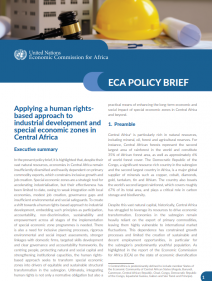
This policy brief examines the application of a human rights-based approach to industrial development and special economic zones in Central Africa. It highlights the continued dependence of the subregion on primary commodity exports despite its abundant natural resources and argues that special economic zones can support economic diversification and structural transformation when aligned with human rights principles. The publication discusses key challenges affecting special economic zones, including weak linkages with local economies, limited job creation, governance gaps, and inadequate environmental and social safeguards. It proposes the integration of participation, accountability, non-discrimination, equality, sustainability and empowerment into the planning, design and management of special economic zone programmes. The brief recommends inclusive stakeholder engagement, environmental and social impact assessments, skills development initiatives, stronger support for micro-, small and medium-sized enterprises, effective governance mechanisms and environmental, social and governance standards. It concludes that a human rights-based approach can enhance the economic, social and environmental sustainability of industrial development and special economic zones in Central Africa.