Overview
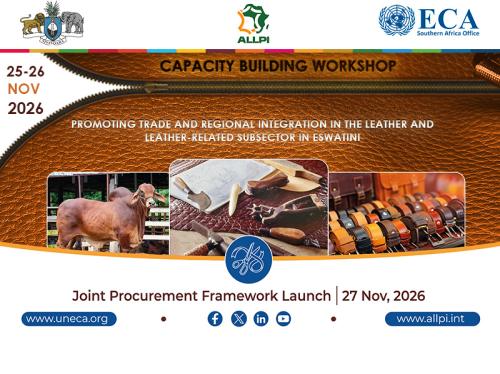
The UN Economic Commission for Africa (ECA), the Africa Leather and Leather Products Institute (ALLPI) and the Government of the Kingdom of Eswatini will convene a two-day capacity-building workshop to strengthen the technical and business capabilities of micro, small and medium-sized enterprises (MSMEs) in the leather and leather products subsector. The programme will culminate in the launch of the Joint Procurement Framework on 27 November 2026.
Part of the initiative on Promoting Trade and Regional Integration in the Leather and Leather-related Subsector in Eswatini, the workshop supports improved productivity, raw-material access and regional market participation. The initiative addresses high and unpredictable input costs, limited working capital, inconsistent product quality, fragmented sourcing and weak business management.
The initiative’s Leather Value Chain Joint Procurement Framework (JPF), developed and validated to coordinate bulk sourcing, aims to provide quality raw materials at competitive prices through reliable supply arrangements. The workshop will equip enterprises with practical knowledge, tools and skills to apply the validated framework in daily operations.
Objectives
The workshop aims to enable leather MSMEs in Eswatini to utilise the Joint Procurement Framework effectively and strengthen their production efficiency, business management and competitiveness.
Specifically, the workshop will:
- Familiarise participating MSMEs with the Joint Procurement Framework, its governance arrangements and operational procedures.
- Strengthen enterprise capabilities in demand forecasting, collective ordering and procurement planning.
- Enhance knowledge of raw-material specifications, quality assurance and inventory management.
- Build practical skills in costing, pricing, cash-flow management and financial record-keeping.
- Promote responsible participation in collective procurement arrangements, including repayment discipline and risk management.
- Support enterprises in developing practical business models and individual enterprise action plans.
Key Focus Areas
The three-day programme will translate the Joint Procurement Framework into practical business applications across the following thematic areas:
Day 1: Understanding and Utilising the Joint Procurement Framework
Sessions will introduce participants to the framework’s membership obligations, procurement cycles, input specifications, demand forecasting and collective ordering arrangements.
Day 2: Strengthening Enterprise and Business Management Capabilities
Sessions will cover costing and pricing, cash-flow management, financial record-keeping, inventory control and responsible access to in-kind support. Participants will also develop a Business Model Canvas and individual enterprise action plans.
Day 3: Practical Application of the Joint Procurement Framework
Participants will undertake practical exercises to strengthen their understanding and application of the framework and prepare for effective participation in collective procurement arrangements.
Expected Outcomes
The workshop is expected to support the following outcomes:
- Enhanced capacity of leather MSMEs to utilise the Leather Value Chain Joint Procurement Framework.
- Improved enterprise capabilities in local sourcing, production planning and business management.
- Increased access to quality raw materials and other essential production inputs.
- Improved productivity and competitiveness of leather enterprises.
- Strengthened participation of Eswatini MSMEs in regional markets.
Expected Outputs
The initiative is expected to produce the following outputs:
- A validated Leather Value Chain Joint Procurement Framework to guide governance and strategic bulk sourcing.
- Capacity-building support for at least 20 MSMEs to effectively utilise the framework.
- Workshop proceedings reports documenting key discussions, recommendations, and outcomes.
Target Participants
The workshop will target at least 20 MSMEs in Eswatini’s leather and leather products sector, including producers of footwear, bags, belts and other leather accessories.
ALLPI, in collaboration with the ministry responsible for industry and commerce in Eswatini, will identify participating enterprises through a survey-led approach.
Implementing Partners
The initiative is being implemented by the following partners:
- United Nations Economic Commission for Africa (ECA): Provides financing and implementation support.
- Africa Leather and Leather Products Institute (ALLPI): Provides specialised technical guidance, leather value-chain expertise, training tools and quality assurance.
- Government of the Kingdom of Eswatini: Acts as the national counterpart through the ministry responsible for industry and commerce, facilitating government coordination, stakeholder engagement and access to beneficiaries.
About the Initiative
The initiative aims to advance inclusive industrialisation, entrepreneurship, employment creation, women’s economic empowerment and regional trade by developing Eswatini’s leather value chain.
By strengthening collective procurement arrangements and enterprise capabilities, the initiative seeks to address structural constraints facing local leather businesses and support their integration into regional markets.
Lessons learned and successful practices will inform potential replication and scale-up in other Southern African countries.
Contact Information
For further information on the initiative and workshop, please contact:
Jackline Mutambo
Senior Administrative Assistant
ECA Subregional Office for Southern Africa
Email: jackline.mutambo@un.org
Tel: +260 969192690
Additional Contacts:
Ms. Talumba Chilipaine – Economic Affairs Officer, ECA Subregional Office for Southern Africa
Email: talumba.chilipaine@un.org
Ms. Zodwa Mabuza – Regional Advisor on Trade and Regional Integration, ECA Subregional Office for Southern Africa
Email: zodwa.mabuza@un.org
Mr. Nicholas Mudungwe – Executive Director, ALLPI
Email: nmudungwe@allpi.int
Media Enquiries
Bedson Nyoni
Senior Information Management Assistant
ECA Subregional Office for Southern Africa
Email: nyonib@un.org