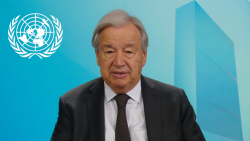
Nairobi, 28 October 2026 - The United Nations Economic Commission for Africa (ECA) today opened a three-day media workshop on health investment in Africa in Nairobi, Kenya, held in collaboration with Twaweza Communications under the Transforming Health Financing in Africa initiative. The workshop brings together journalists from across English speaking Africa, including Botswana, Ethiopia and Sierra Leone, three of the five countries where ECA is working in the first year of the initiative, alongside reporters from Kenya, Rwanda, Tanzania, Uganda, Zambia and Zimbabwe. Over the three days, participants will learn about ECA's work on health financing and share their own experience of the health systems in their countries.
The workshop sets out to change how health is reported in African media. Too often health is covered as a hospital story or a line of public spending. ECA wants journalists to treat it as an economic investment that is central to Africa's sovereignty, economic resilience and justice. The workshop builds on the Declaration on Sustainable Health Financing in Africa, known as the Tangier Declaration, which ministers adopted in April 2026 at the ECA Conference of African Ministers of Finance, Planning and Economic Development, where the initiative was also launched. On average, African governments finance less than 41 per cent of total health expenditure, leaving households and unpredictable donor funding to cover the gap.
Opening the workshop, Aboubakari Diaw, Chief of Staff, ECA and Health Financing Team Lead, said health financing must be understood as a macroeconomic issue rather than a cost. He noted that out of pocket payments make up 35% of health spending in the WHO Africa region, far above the recommended ceiling and that 420 million Africans faced financial hardship from health costs in 2022. Twenty-five years after the Abuja Declaration, only one country has consistently met the commitment to allocate 15% of its public budget to health, while external health aid has fallen by around half.
"Follow the money upstream, from the ward to the Treasury," Mr. Diaw (Chief of staff, ECA) told participants, urging them to question stakeholders such as the UN and WHO, Civil Society across, and, ministers of finance as rigorously as ministers of health and to ask which budget line, which year and what money stands behind each commitment.
Over the coming days, journalists will work through the technical side of health financing with resource persons including Prof. Kimani Njogu, communications specialist form the ECA and David Khaoya, health economist at the University of Nairobi, who will present Kenya's health financing reforms. Kenya was chosen to host the workshop because of its long-term effort to transform its health system. In 2023 the country passed four laws to advance universal health coverage, and in 2024 it replaced the National Hospital Insurance Fund with a new Social Health Authority. Participants will visit the Social Health Authority to see how the system works in practice.
The workshop is the first step in building a network of African journalists who report on health as a driver of development. A second workshop for French speaking media will take place towards the end of the year, and together the two will lay the foundation for a non-resident health financing media fellowship programme in 2027.
Issued by:
Communications Section
Economic Commission for Africa
PO Box 3001
Addis Ababa
Ethiopia
Tel: +251 11 551 5826
E-mail: eca-info@un.org