Related SDGs
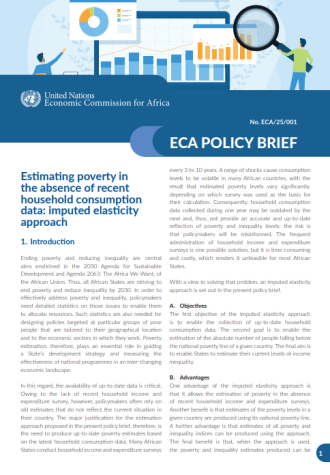
Accurate and timely poverty estimates are crucial for policymaking but are often hindered by the lack of recent household consumption data. This policy brief proposes an imputed elasticity approach to estimate poverty in the absence of up-to-date surveys. The method leverages macroeconomic data—such as GDP growth and inflation rates—along with the latest available household survey to impute current consumption levels. Key advantages include the ability to produce disaggregated poverty and inequality estimates (by region, gender, education, etc.) and align results with national poverty lines. The approach assumes stable income inequality and household demographics in the short run, though its accuracy depends on reliable GDP projections. While cost-effective, limitations include sectoral averaging of consumption growth and exclusion of atypical income shocks. This method offers African policymakers a practical tool to monitor poverty dynamics between infrequent surveys, supporting the 2030 Agenda for Sustainable Development and Agenda 2063 goals.
Publication Series



Publications récentes