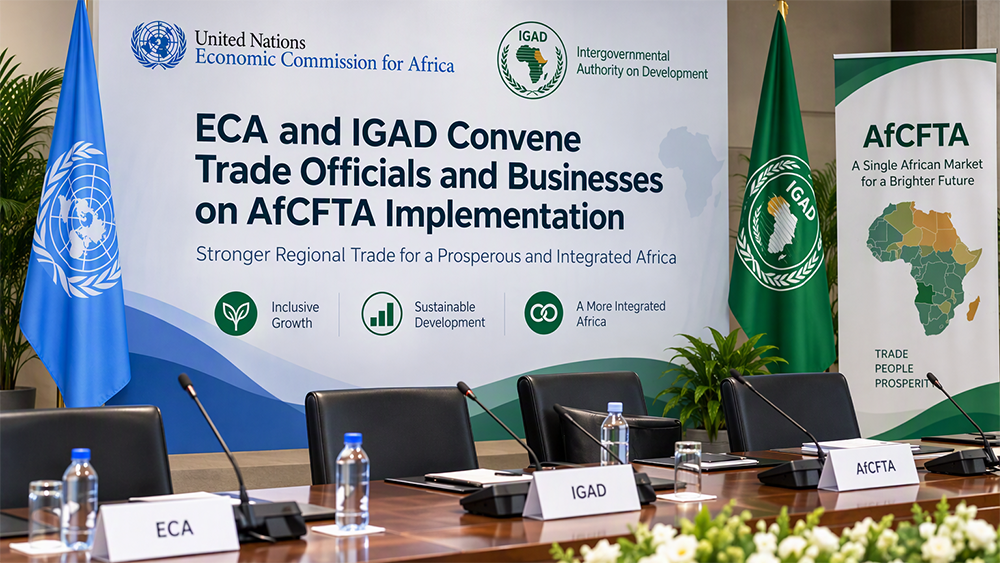
Nairobi, Kenya, 2 November 2026 (ECA) – More than 30 representatives from leading regional companies, trade ministries and business associations gathered in Nairobi for a regional workshop to exchange experiences on the implementation of the African Continental Free Trade Area (AfCFTA) and discuss how businesses can better leverage the agreement to expand trade and investment across Africa.
Jointly organized by the United Nations Economic Commission for Africa (ECA) and the Intergovernmental Authority on Development (IGAD), the workshop brought together senior executives from major firms operating across the IGAD region, alongside trade officials from Djibouti, Ethiopia, Kenya, Somalia, South Sudan, Sudan and Uganda. The two-day meeting provides a platform for dialogue between the public and private sectors on practical challenges, emerging opportunities and lessons learned in implementing the AfCFTA.
Discussions focused on the experiences of businesses trading across borders, persistent barriers affecting regional commerce, and measures needed to improve trade facilitation and market access. Participants also explored how stronger collaboration between governments and the private sector can help unlock the AfCFTA's potential, strengthen regional value chains and increase the participation of African enterprises in continental markets.
Opening the workshop, Andrew Mold, Director of ECA's Office for Eastern Africa, noted that there was a growing sense of urgency regarding the implementation of this historic agreement, and that it was thus essential that the voices of the private sector were listened to.
Melaku Desta, Director of ECA's Regional Integration and Trade Division, highlighted ECA's longstanding support for the AfCFTA, from the negotiation phase to implementation. He noted that ECA has supported the development of 44 national AfCFTA implementation strategies and continues to assist countries in translating the agreement into tangible economic opportunities for businesses and citizens.
According to recent UNCTAD data data, intra-African trade reached an estimated US$217.8 billion in 2025, reflecting a 7 per cent increase from the previous year.
Speaking on behalf of the Government of Kenya, Alex Tomerang, Deputy Director of Trade at the State Department for Trade, stressed that the role of governments in AfCFTA implementation is to facilitate trade and create an enabling environment that allows businesses to fully take advantage of opportunities created under the agreement.
Despite encouraging progress, significant challenges remain. Mr. Tomerang further noted that while African countries have invested significant effort in negotiating the AfCFTA, the focus must now shift towards ensuring that the private sector can effectively utilize the framework to expand trade, investment and economic growth across the continent.
Also addressing the workshop, Ismail Garo, Head of Trade, Industry and Tourism at IGAD, stressed that the effectiveness of the AfCFTA should be measured not by the number of agreements signed but by the extent to which businesses are able to trade more easily across borders, expand production and create employment opportunities.
The workshop forms part of efforts to implement the IGAD AfCFTA Regional Strategy, adopted in 2024 with support from ECA. Consultations conducted across the region identified key obstacles to greater intra-African trade, including high transport and logistics costs, cumbersome customs procedures, limited access to market information, compliance challenges related to standards and sanitary requirements, and constraints in accessing finance.
Participants called for enhanced trade facilitation, stronger regional value chains, harmonized standards and expanded public-private dialogue. The workshop is also expected to contribute to the establishment of a network of AfCFTA Enterprise Champions who will advocate for practical solutions to trade bottlenecks and promote wider participation in regional and continental markets.
The meeting is expected to generate actionable recommendations that will inform future support by ECA, IGAD and Member States to accelerate AfCFTA implementation and unlock the region's trade, investment and industrialization potential.
Click here to download : AfCFTA Business Toolkit: Practical Digital Tools for Enterprise Coaching and Trading
Issued by:
Communications Section
Economic Commission for Africa
PO Box 3001
Addis Ababa
Ethiopia
Tel: +251 11 551 5826
E-mail: eca-info@un.org