
Registration link: https://indico.un.org/event/1025300
The Statistical Commission for Africa is the regional equivalent of the Statistical Commission of the Economic and Social Council, which is the highest body in the global statistical system. The Statistical Commission for Africa is the highest decision-making body in Africa responsible for setting statistical standards, developing concepts and methods and implementing them at the national, subregional and continental levels. The meeting provides an opportunity for participants to discuss the link between African and global statistical systems to ensure that Africa is not left behind in global statistical initiatives. Participants will also be able to discuss progress and statistical development in African statistical systems. Furthermore, the meeting will serve as a platform for international partners to meet representatives of member States of the Economic Commission for Africa to discuss the needs of those member States.
The meeting will provide Member States with an opportunity to take stock of ongoing global initiatives and to seek ways to mainstream and take ownership of new and updated methodologies to enhance their statistical capacity. Particular emphasis will be placed on how to modernize and transform national statistical systems in Africa to ensure that the data needed for subregional and continental integration and the global agendas are available.
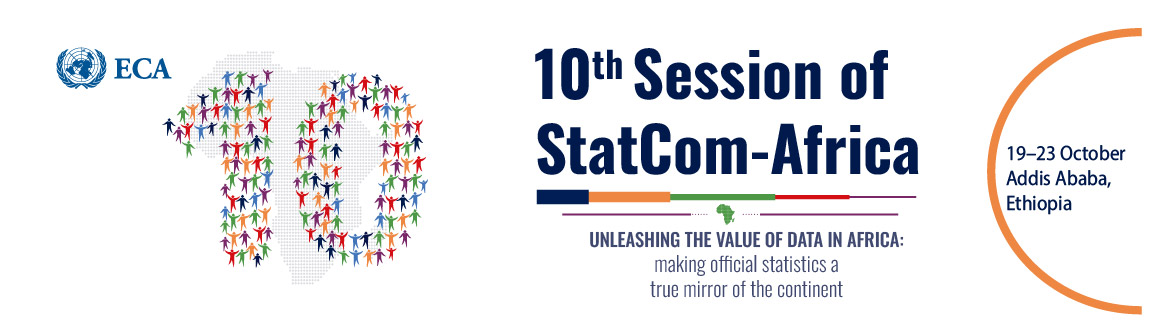
The tenth session of the Statistical Commission for Africa will be held under the theme “Unleashing the value of data in Africa: making official statistics a true mirror of the continent”. The theme responds to a central challenge facing African statistical systems today. The continent is producing ever-growing volumes of data, yet the connections between statistics and livelihood transformation remain vulnerable to questions of trustworthiness and to the full harnessing of their potential. In many cases, data exist but are not sufficiently integrated to address the complex development challenges confronting the global economy and to respond to the continent's contextual demands. The foregoing underscores the fact that the value of data lies not in their production alone, but in their transformation into accessible, trusted and actionable information that supports evidence-based decision-making, inclusive growth and sustainable development.