
For virtual participation register here
Introduction
Africa has been an important normative and negotiating actor in the global climate regime, particularly on adaptation, climate justice, equity, loss and damage, and the operationalization of common but differentiated responsibilities and respective capabilities (CBDR-RC). However, it is recognized that leadership in global climate governance cannot be assumed simply because African priorities are articulated or defended in negotiations. Leadership must be understood as the capacity to shape agendas, influence norms, design institutions, build coalitions, and develop practical solutions that improve outcomes for all Parties.
The Fourteenth Conference of Climate Change and Development in Africa (CCDA-XIV) therefore introduces a more demanding framing: moving beyond strengthening African climate leadership toward strengthening African agency in shaping the rules, institutions, norms, implementation architectures, and political bargains that define global climate governance.
The outcomes of the Sixty-Fourth Sessions of the United Nations Framework Convention on Climate Change (UNFCCC) Subsidiary Bodies (SB64), held in Bonn in June 2026, underscored both progress and persistent gaps across key areas of the climate agenda. Discussions advanced technical work on adaptation, transparency, Article 6, just transition, and preparations for COP31, while longstanding challenges remain regarding climate finance, implementation support, loss and damage, and the delivery of commitments under the first Global Stocktake (GST1). These developments reinforce the need for stronger implementation, enhanced international cooperation, and more effective support for developing countries.
These challenges raise a deeper question that will guide CCDA-XIV: Where is the current climate regime failing to deliver equitable and development-compatible outcomes, and what solutions can Africa contribute to strengthen global climate governance?
Building on this momentum, the Seventh Africa Climate Talks (ACT7), convened in April 2026 under the theme "Africa's Road to COP32: Urgency, Leadership and Action" provided a strategic continental platform for consolidating Africa's priorities ahead of SB64, COP31 and COP32. ACT7 emphasized the imperative of moving from commitments to implementation through strengthened accountability, climate finance, adaptation, scientific integrity, trade and climate, and structural transformation. It also reinforced the need for a coordinated African approach that translates ambition into politically resilient and implementable actions, positioning the continent to exercise effective leadership in shaping the future of global climate governance. CCDA-XIV, thus, proposes a strategic shift. Rather than focusing exclusively on what Africa should seek from COP31, the Conference will also ask what Africa should propose to the world at COP31 and how those ideas can mature into globally relevant initiatives through Ethiopia's stewardship of COP32 in 2027.
At the same time, climate change is increasingly shaping broader development, socioeconomic and peace and security priorities. The transition towards low-emission and climate-resilient economies is transforming trade and investment patterns, industrial development, energy systems, food systems, public health, and regional stability. It is also creating new opportunities to advance green industrialization, circular economy approaches, sustainable consumption and production, value addition to Africa's critical minerals, and resilient infrastructure. These transitions present both opportunities and challenges for Africa as countries seek to accelerate economic transformation, expand energy access, create decent jobs, strengthen resilience, and enhance long-term competitiveness in a rapidly changing global economy. CCDA-XIV therefore positions Africa not merely as a stakeholder impacted by evolving governance arrangements, but as a potential architect of new approaches to climate-development governance.
Although Africa contributes less than four per cent of global greenhouse gas emissions, it remains one of the region’s most vulnerable to climate impacts. Rising temperatures, prolonged droughts, floods, cyclones, biodiversity loss, and climate-related health risks continue to undermine livelihoods, infrastructure, natural resources, and economic growth across the continent. Addressing these challenges requires significantly greater access to climate finance, technology transfer, capacity development, and knowledge, while ensuring that global climate responses adequately reflect Africa's development priorities and circumstances.
Realizing Africa's climate and development ambitions will also depend on strengthening the use of science, data, technology, and innovation. Robust climate information systems, early warning services, Earth observation, research, and evidence-based policymaking are essential for improving climate risk management, guiding investments, tracking implementation progress, and supporting national and regional planning. Strengthening the science-policy interface will therefore be central to delivering effective, accountable, and transformative climate action across the continent.
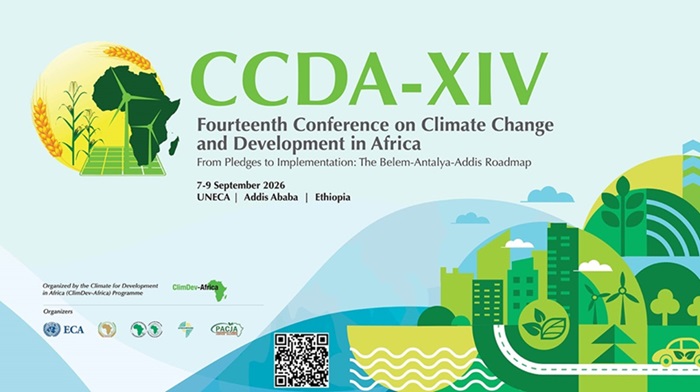
The CCDA-XIV, convened under the Climate for Development in Africa (ClimDev-Africa) Programme, provides a strategic platform to translate Africa's climate ambitions into implementation and delivery. Convened after ACT7 and SB64 and ahead of the United Nations General Assembly (UNGA) and COP31, the conference will bring together policymakers, negotiators, researchers, development partners, financial institutions, civil society, youth, women, Indigenous Peoples, local communities, and the private sector to consolidate Africa's priorities, mobilize partnerships and investments, and strengthen coordinated action towards COP31 while laying the strategic foundations for an African-led COP32.
Under the theme "From Pledges to Implementation: The Belem- Antalya- Addis Roadmap" CCDA-XIV will focus on accelerating implementation of global and national climate commitments, strengthening policy coherence across climate and development priorities, promoting science-driven and evidence-based decision-making, and fostering partnerships that support resilient, inclusive, and low-emission development. The conference will culminate in the adoption of the Addis Ababa Climate Action Messages, providing Africa's consolidated policy priorities, implementation recommendations, and strategic messages for COP31 while establishing a shared continental roadmap towards COP32.
CCDA-XIV is, therefore, consequently structured around a progression from African realities, to African diagnosis of global governance challenges, to African propositions for reform, to coalition-building at COP31, culminating in support for Ethiopia's preparation to broker globally relevant outcomes at COP32.
Why CCDA-XIV?
CCDA-XIV is critical platform for African stakeholders because the next phase of African climate influence requires more than effective negotiation. It requires agency. While African countries must continue defending core priorities relating to equity, adaptation, finance, development space, energy access and special circumstances, they must increasingly demonstrate the capacity to define global problems, generate credible solutions, build coalitions around them and shape implementation architectures.
The Conference therefore serves four strategic purposes:
- Consolidate African priorities for COP31.
- Develop African propositions for improving global climate governance.
- Test these propositions with other negotiating groups and partners before COP31.
- Generate options for Ethiopia's future role as an impartial COP32 Presidency capable of helping Parties resolve complex global challenges.
CCDA-XIV will function as the intellectual and policy engine supporting African climate diplomacy, while recognizing that formal negotiating positions remain the responsibility of established AGN, AU and governmental processes.
Objectives
The overall objective of CCDA-XIV is to strengthen Africa's climate leadership by advancing coordinated policy, partnerships, investments, and implementation that accelerate climate-resilient and low-emission development, shape Africa's strategic engagement at COP31, and lay the foundation for an ambitious and African-led COP32. In doing so, CCDA-XIV anchors the Conference's central theme of moving from commitments to delivery, ensuring Africa's climate and development agenda translates into politically resilient, implementable outcomes for the AGN and the continent's broader climate and development partners.
Specific Objectives
- Assess the implications of SB64 and identify priority areas where Africa can exercise greater agenda-setting, normative, coalitional, design and implementation leadership.
- Develop African propositions that address weaknesses in global climate governance and contribute solutions of relevance to the wider international community.
- Advance differentiated approaches to climate-development transitions that recognize varying levels of energy poverty, industrialization, emissions responsibility, technological capability and development need.
- Promote a coherent African vision for reforming international climate finance architecture, including issues of provision, mobilization, concessionality, debt sustainability, adaptation finance and responsibility-based support.
- Position Africa as a leader in defining adaptation success, adaptation accountability, climate-risk management and resilience governance.
- Advance African proposals on climate-compatible trade, industrialization, critical minerals governance and green structural transformation.
- Strengthen science, innovation, climate information services and evidence generation as foundations for implementation leadership.
- Support coalition-building between Africa and other negotiating constituencies ahead of COP31.
- Distinguish clearly between African substantive leadership and Ethiopia's future COP32 Presidency role, and support development of globally relevant Presidency initiatives.
Expected outcomes
CCDA-XIV is expected to deliver the following outcomes:
- A clearer African diagnosis of weaknesses within existing climate governance arrangements.
- A set of African governance propositions addressing climate finance, adaptation, trade, energy transitions, critical minerals, resilience and climate-risk management.
- A COP31 African strategic intervention framework outlining priorities, partnerships, alliance opportunities and potential landing zones.
- A COP32 Presidency Options Paper identifying candidate initiatives Ethiopia could potentially develop as an impartial Presidency.
- Strengthened collaboration between African institutions and other negotiating groups, development partners, MDBs, researchers and civil society.
- A unified African Common Position, developed with and validated by the AGN, ready to guide Africa's engagement at COP31.
- A strengthened continental platform for climate leadership and coordinated action.
Conference deliverables
CCDA-XIV will deliver:
- The CCDA-XIV strategic messages, articulating Africa's common priorities and recommendations for COP31 and strategic directions towards COP32.
- Summary report capturing the main discussions and policy recommendations that support implementation of the Paris Agreement, GST1 outcomes, NDCs 3.0 and National Adaptation Plans.
- A strengthened network of partnerships among governments, regional institutions, development partners, research organizations, civil society and the private sector to advance implementation.