
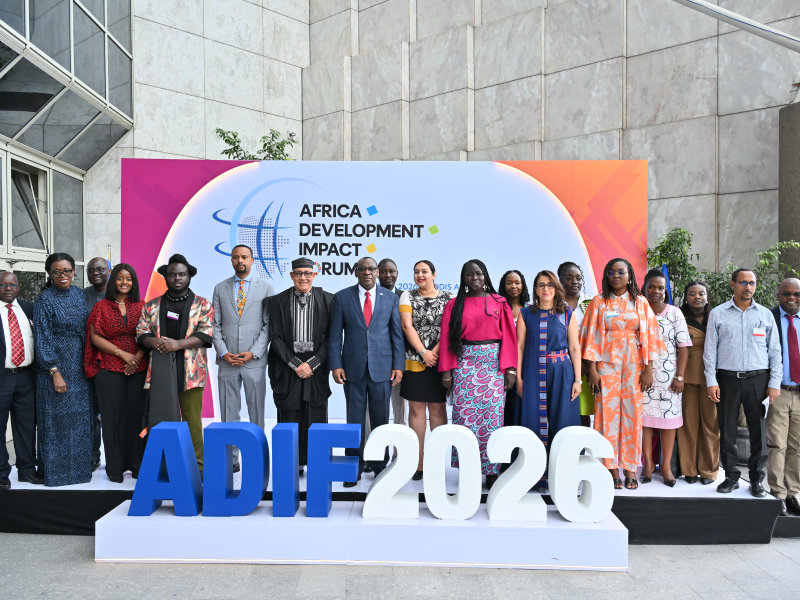
Addis Ababa,11 June 2026 (ECA) — The inaugural Africa Development Impact Forum (ADIF) concluded its first day in Addis Ababa on Thursday with a full programme of high-level dialogue, policy innovation and youth-centred debate, as hundreds of researchers, entrepreneurs, policymakers and young Africans convened at the United Nations Conference Centre to move the continent from conversation to action on job creation.
Spanning five thematic sessions, a landmark youth dialogue on global finance, and a live policy hackathon, Day One made clear that Africa's challenge is not a shortage of ideas, it is a shortage of the systems, financing and political will to scale them.
Confronting the Global Financial Architecture
The morning opened with a frank and data-driven dialogue on the global financial architecture, a session that set a tone of urgency and agency for the rest of the day.
Deputy Executive Secretary and Chief Economist of ECA, Hanan Morsy, presented the structural realities constraining Africa's development to members of the Young Economists Network, drawn from universities across Benin, Cameroon, Côte d'Ivoire, the Democratic Republic of the Congo, Ethiopia, Kenya, Senegal and Tunisia.
The figures were unambiguous. Africa faces a financing gap of nearly $1.3 trillion to meet the Sustainable Development Goals. More than 25 African countries are in debt distress or at high risk. In 2025, African governments paid over $100 billion in public debt repayments, more than many spent on critical social sectors. And Africa receives just 3.6% of global climate finance, despite contributing less than 4% of global emissions.
But the dialogue moved deliberately beyond diagnosis. Ms. Morsy outlined four reform priorities, a debt system that works for development, lower costs of capital, climate finance that serves Africa, and stronger domestic resource mobilization and called on young Africans to own this agenda at every level.
"You are not merely stakeholders in Africa's future. You are authors of it," she told participants.
ECA Executive Secretary Claver Gatete opened the Forum with a clear-eyed assessment of where Africa stands and what the continent must do next.
"If Africa's greatest challenge is jobs, then Africa's greatest opportunity is also jobs. We already have the ideas, the talent, the resources, a dynamic private sector and the market to transform our economies. What we need now is execution," Mr. Gatete said.
He later closed the youth dialogue session with a direct challenge to the room. Drawing on his experience as a former Minister of Finance, he noted that the most consequential insight often comes not from ministers and senior officials but from young people, those who will live longest with the decisions being made. "Involving you is not enough. We must empower you. You give ideas when you are well-informed. And we are ready to assist you in this process."
Nine Innovators. Six Judges. One Question.
The morning's Policy and Strategy Hackathon, the "Hack the Job Challenge", brought the Forum's competitive energy to the fore. Nine innovators from Rwanda, Ethiopia, Ghana, Cameroon, Burkina Faso, Kenya, South Africa, Togo and the Democratic Republic of the Congo each had five minutes to pitch a scalable job creation solution to a panel of six expert judges from ECA, UNDP, ILO, UNESCO, PEMANDU Associates and UN Women.
Pitches ranged from a pan-African youth employment platform connecting skills, SMEs and investors across four pillars, to a solar workforce development initiative training youth and women to build clean energy micro-grids in communities without grid access. Other contestants presented models for agro-industrial ecosystems, a credentialing platform tackling the "no job, no experience" cycle that leaves 60% of Ghana's 300,000 annual graduates unemployed, and a decentralized productive transformation framework for the DRC.
One theme cut across every pitch: the problem is not that Africa lacks solutions. It is that the financing, regulation, market access and policy systems have not caught up.
The winner will be announced on Day Two.
Entrepreneurship, AI and Trade: Three Afternoon Sessions
Three thematic sessions drove the afternoon's agenda.
The session on youth entrepreneurship challenged whether entrepreneurship should be understood simply as a job substitute or as something broader, a set of transferable skills and a system-level lever for inclusion and resilience. Panellists and audience members pushed back against programmes that reach only already-visible, networked founders, calling for deliberate inclusion of informal entrepreneurs, women and rural innovators. The consensus: impact is not measured by the number of startups launched but by who is included, who survives, and who scales.
The session on artificial intelligence and jobs examined one of the most contested questions in Africa's development conversation. With AI projected to unlock over $100 billion in economic value across more than 20 sectors while putting 16.7 million jobs at productivity risk, panellists debated whether Africa's youth demographic is a structural asset or a structural vulnerability in the AI transition. The emerging consensus: AI adoption in Africa's largely informal economy must be context-specific, and youth should be seen not as passive recipients of disruption, but as potential AI trainers, data labellers and prompt specialists provided access and enabling environments keep pace.
The session on regional value chains under the African Continental Free Trade Area heard directly from youth-led entrepreneurs navigating cross-border trade. Founders from Zimbabwe, South Africa, Rwanda and Ethiopia shared lived experiences of logistics delays, currency volatility, inaccessible trade finance and fragmented dispute resolution, and the innovations they have built around these barriers rather than waiting for them to be solved. The session affirmed what is increasingly clear: young people are not merely beneficiaries of AfCFTA. They are its most dynamic anchors of innovation.
The day closed with an impact talk on translating the UN Pact for the Future into language and formats accessible to the generation most critical to its implementation, with a clear message that the shift required is from engaging youth to co-leading with them.
Issued by:
Communications Section
Economic Commission for Africa
PO Box 3001
Addis Ababa
Ethiopia
Tel: +251 11 551 5826
E-mail: eca-info@un.org