Rabat (Morocco), 6 November 2026 (ECA) - The ECA Office for North Africa concluded its 41st session of the Intergovernmental Committee of Senior Officials and Experts (ICSOE) on Thursday 5 November 2026. Key recommendations from the meeting called on North African countries to:
- strengthen their capacity to anticipate and address climate change risks through innovative mitigation and adaptation measures, including improving resource governance, promoting the use of renewable energy and adopting sustainable agricultural land management practices;
- adopt strategic foresight and prospective approaches to policy development;
- use green and sustainable finance by developing appropriate frameworks, strategies and financing instruments to achieve climate-resilient and low-carbon development;
- use big data, innovation and artificial intelligence to inform evidence-based policymaking and increase regional cooperation on economic resilience.
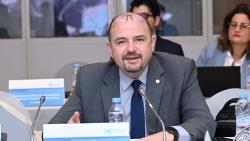
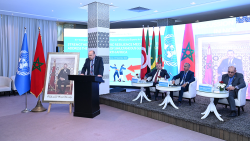
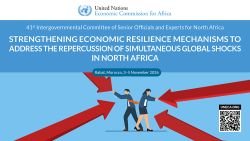
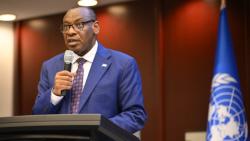
This year’s ICSOE session was held under the theme “Strengthening economic resilience mechanisms to address the repercussion of simultaneous global shocks in North Africa.” During the session, participants reviewed the achievements of the ECA Office for North Africa over the past year, its proposed work programme and strategic orientations for the year ahead.
The ICSOE session, held from 3 to 5 November 2026, and the ad-hoc expert group meeting, held on 4 November, provided country representatives and experts with a platform to share experiences and best practices for mitigating the impact of multiple and overlapping shocks.
Additional recommendations called on member countries to maintain ongoing efforts to:
- implement reforms to preserve macroeconomic stability and build economic resilience;
- develop flexible and adaptable fiscal frameworks and resilient financial systems, while strengthening public financial management and domestic resource mobilization;
- improve debt sustainability, enhance debt management practices, and strengthen national capacities to manage risks and assess the trade-offs between different sources of financing;
- and advance the implementation of AfCFTA national strategies, reinforce regional coordination and South-South cooperation, and establish effective partnerships.
For its part, the United Nations Economic Commission for Africa was tasked with:
- conducting analytical work on resilient growth, including examining social, economic and ecological interlinkages;
- developing strategic tools, including AI, to support Member States in developing and implementing adaptive transition pathways;
- supporting Member States in developing transversal strategies for resilience;
- maintain its support to Member States with regards to enhancing domestic resource mobilization, improving debt management, developing sustainable and green finance strategies, and maximizing the potential of remittances.
Recommendations from the 41st ICSOE session and the expert group meeting will be submitted to the 59th Session of the Economic Commission for Africa and Conference of Ministers of Finance, Planning and Economic Development (COM2027) scheduled to take place in Addis Ababa, Ethiopia, from 17 to 23 March 2027, under the theme “Shaping the future of work in Africa: youth employment.”
Based in the Kingdom of Morocco since 1963, the United Nations Economic Commission for Africa’s Office for North Africa supports seven countries: Algeria, Egypt, Libya, Mauritania, Morocco, Sudan, and Tunisia. Its goal is to contribute to enhancing the environment for accelerated and inclusive growth and sustainable development in North Africa.
Note to editors
For more information about these meetings, please visit https://www.uneca.org/forty-first-session-icsoe-north-africa. To request an interview with our experts, please email filali-ansary@un.org or a WhatsApp message to: (+212) 673 734 462.
High resolution, copy-right free photos of the event will be provided on demand and through the ECA Flickr page.
Issued by:
Communications Section
Economic Commission for Africa
PO Box 3001
Addis Ababa
Ethiopia
Tel: +251 11 551 5826
E-mail: eca-info@un.org